
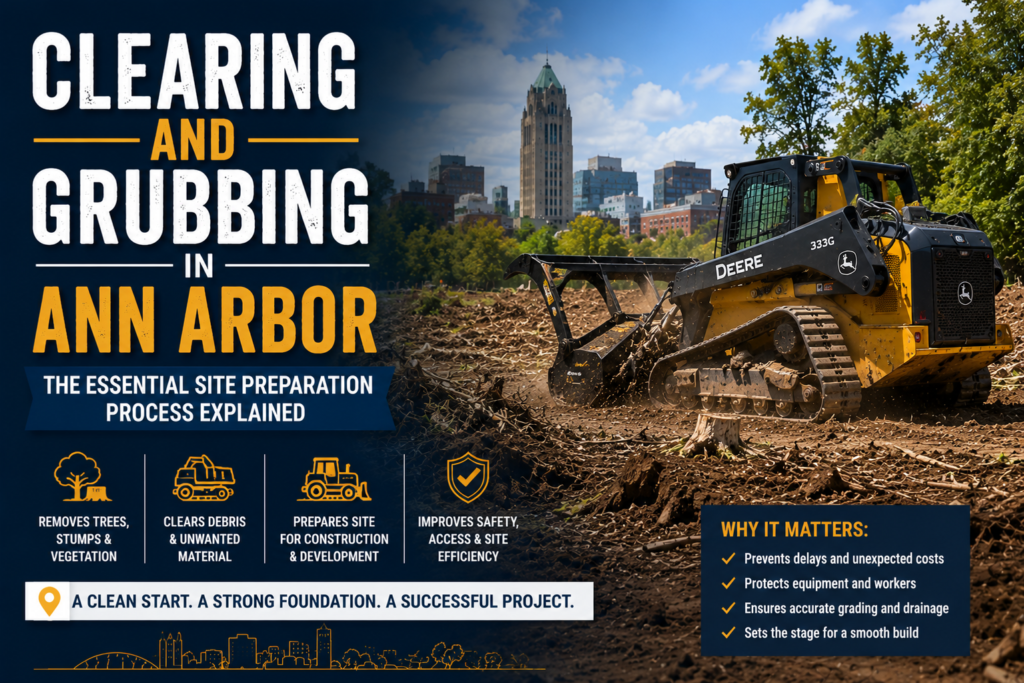
Land development projects do not begin with a foundation or a framing crew. They begin underground with the systematic removal of everything that would compromise the long-term stability and usability of the land being developed. This process is known as clearing and grubbing, and it is one of the most critical early phases in any construction project that starts from undeveloped or vegetated ground.
In Ann Arbor and across Washtenaw County, where wooded properties are common, glacially deposited clay soils demand careful site preparation, and strict environmental regulations govern how land is disturbed near waterways, Clearing And Grubbing Ann Arbor is not merely a preliminary step it is a foundational investment in the integrity of everything that follows. Property owners, developers, and builders who understand what this process involves are better positioned to plan their projects realistically and achieve the clean, stable site conditions that good construction demands.
What Is Clearing?
Clearing is the first phase of the two-part clearing and grubbing process, and it addresses everything that is visible above the ground surface. Clearing removes trees, shrubs, brush, vines, tall grasses, weeds, fallen logs, accumulated organic debris, and any other surface-level vegetation or material that would obstruct construction activity or interfere with grading and foundation work.
The methods used for clearing depend on the size and density of the vegetation, the size of the parcel, the intended use of the cleared land, and any environmental constraints that apply. Mechanical clearing using bulldozers, excavators, and skid steer loaders is the most common approach for most development projects. A bulldozer can efficiently push over and pile trees for later processing, while an excavator provides more precise control for selective removal. Forestry mulchers specialized machines that grind standing trees, brush, and vegetation into fine wood chips in a single pass are an increasingly popular alternative on projects where the mulch layer can remain on the ground, as they eliminate the need to haul large volumes of woody debris off-site.
The practical outcome of clearing is an accessible site: a space where construction equipment can move safely, where the soil can be assessed and tested, and where the grubbing phase can begin. A properly cleared site is free of above-ground obstacles but may still contain a significant amount of root material and organic matter beneath the surface which is where grubbing takes over.
What Is Grubbing?
Grubbing is the second phase of the clearing and grubbing process, and it is focused entirely on what lies below the ground surface. After the above-ground vegetation has been removed, grubbing extracts the root systems, stumps, buried logs, and other organic material that remain in the soil. This is the step that is critical for long-term site stability and is the key distinction between a site that has been cleared and one that has been truly prepared for construction.
The reason grubbing is so important comes down to organic decomposition. Roots, stumps, and buried wood are organic materials that will decompose over time after they are left in the ground. As they decay, they create voids empty spaces in the soil where material once was and these voids cause the ground above them to settle unevenly. For construction projects, this uneven settlement is catastrophic: it can crack foundations, distort floor slabs, break underground utility lines, and create drainage problems that persist for the life of the structure.
The grubbing process uses excavators fitted with root rakes, bucket attachments, and grading blades to dig out and remove stumps and root masses from the soil. For very large trees with extensive root systems, significant excavation may be required to extract the root ball completely. Smaller roots particularly fine roots that permeate the soil in all directions around a removed tree are typically addressed by removing the topsoil layer (which contains the highest density of organic material) and replacing it with clean, inorganic fill in areas where foundations, slabs, or other structures will bear directly on the ground.
Why Clearing and Grubbing Must Both Be Done
A common misunderstanding in construction project planning is treating clearing and grubbing as interchangeable or assuming that clearing alone is sufficient. In reality, clearing without grubbing leaves a site that looks clean from above but is structurally compromised below. The stumps and roots that remain will decompose, causing settlement. They may also sprout new growth, particularly for species like tree-of-heaven, silver maple, and other vigorous regenerators common in Michigan.
On sites where foundations, slabs, roads, or utility lines will be installed, grubbing is not optional. The International Building Code and standard geotechnical practice both require that organic material be removed from beneath structural elements. A building inspector in Ann Arbor will not approve a foundation that has been placed over material that is known to be subject to organic settlement.
For sites where clearing is performed for purposes other than immediate construction creating a clearing in a wooded property, establishing a lawn area, or developing a garden space grubbing may not need to be as thorough as it would for a construction application. However, even in these cases, stump removal and at least partial root extraction is typically beneficial to prevent regrowth and facilitate proper grading and lawn establishment.
Clearing and Grubbing in Ann Arbor’s Environment
Washtenaw County’s forested properties present some of the most demanding clearing and grubbing conditions in Southeast Michigan. Ann Arbor and its surrounding townships are home to mature stands of oak, maple, hickory, beech, and a variety of invasive species including tree-of-heaven, autumn olive, and Japanese knotweed. These species have different rooting characteristics that affect the grubbing process: oaks have deep, extensive tap root systems that require significant excavation to remove, while shallow-rooted species like silver maple may leave a tangled mat of roots near the surface.
Michigan’s clay-heavy soils create additional complexity. Clay soils tend to adhere to root masses, making root extraction more labor-intensive than in sandy or loamy soils. Wet spring conditions common in Washtenaw County can make clay soils so soft that heavy equipment creates deep ruts and further disturbs the soil structure. Experienced clearing and grubbing contractors in the Ann Arbor area time their operations appropriately and select equipment suited to wet-weather conditions, using track-mounted machines rather than wheeled equipment when soil conditions are borderline.
The Huron River watershed, which encompasses Ann Arbor and much of Washtenaw County, imposes additional constraints on clearing and grubbing operations near waterways. Michigan’s Soil Erosion and Sedimentation Control (SESC) regulations require erosion control measures on clearing operations greater than one acre or within 500 feet of a lake or stream. This typically involves silt fences, erosion control blankets, and stabilized construction entrances measures that must be installed before clearing begins and maintained throughout the duration of the project.
The Sequence of Work: Clearing, Grubbing, and What Comes Next
Clearing and grubbing are preparatory phases that set the stage for what follows. After a site has been cleared and grubbed, the next step is typically rough grading shaping the ground to the general elevations and slopes required by the site engineering plan. This may involve both cutting (removing material from high areas) and filling (importing material to raise low areas). All fill must be placed in controlled lifts and compacted to the specified density to ensure it will support the loads placed upon it.
On sites where significant vegetation has been removed, topsoil stripping is often performed as part of the clearing operation. The topsoil layer typically the upper six to twelve inches of soil is rich in organic material and is not suitable as a structural fill. It is stripped and stockpiled separately so that it can be spread later for lawn establishment, landscaping, or erosion control. The exposed subgrade beneath the topsoil is then the material on which structural fill and foundations are placed.
Following grading, underground utility installation (water, sewer, storm drain, gas, electric) proceeds. Foundation excavation comes next. The careful, complete execution of clearing and grubbing at the beginning of this sequence ensures that every subsequent phase proceeds on stable, well-prepared ground.
Environmental Considerations in Michigan
Michigan has a robust framework of environmental regulations that govern land disturbance activities, and clearing and grubbing operations in the Ann Arbor area frequently intersect with these requirements. In addition to the SESC permit requirements under Part 91 of NREPA, wetland disturbance associated with clearing operations requires authorization under Part 303 (Wetlands Protection) and potentially under Section 404 of the federal Clean Water Act. Tree removal permits may also be required in certain jurisdictions for clearing trees above a specified trunk diameter.
A clearing and grubbing contractor familiar with Ann Arbor and Washtenaw County’s regulatory landscape handles the permit applications and compliance measures as a standard part of their service, protecting property owners from regulatory surprises and ensuring that the project proceeds without enforcement issues.
Final Thoughts
Clearing and grubbing in Ann Arbor is a two-phase process that addresses both the visible surface of a development site and the hidden root and organic material that lies beneath. Both phases are essential for creating the stable, construction-ready ground that every subsequent phase of a project depends on. Understanding the distinction between clearing and grubbing, why both are necessary, and how Ann Arbor’s particular soil conditions and regulatory environment shape this work helps property owners and developers plan their projects with appropriate realism and achieve the best possible outcomes from the ground up.